WHOLE CHILD FRAMEWORK
We are committed to focusing on the whole child and view children through multifaceted lenses, transcending traditional grading systems.
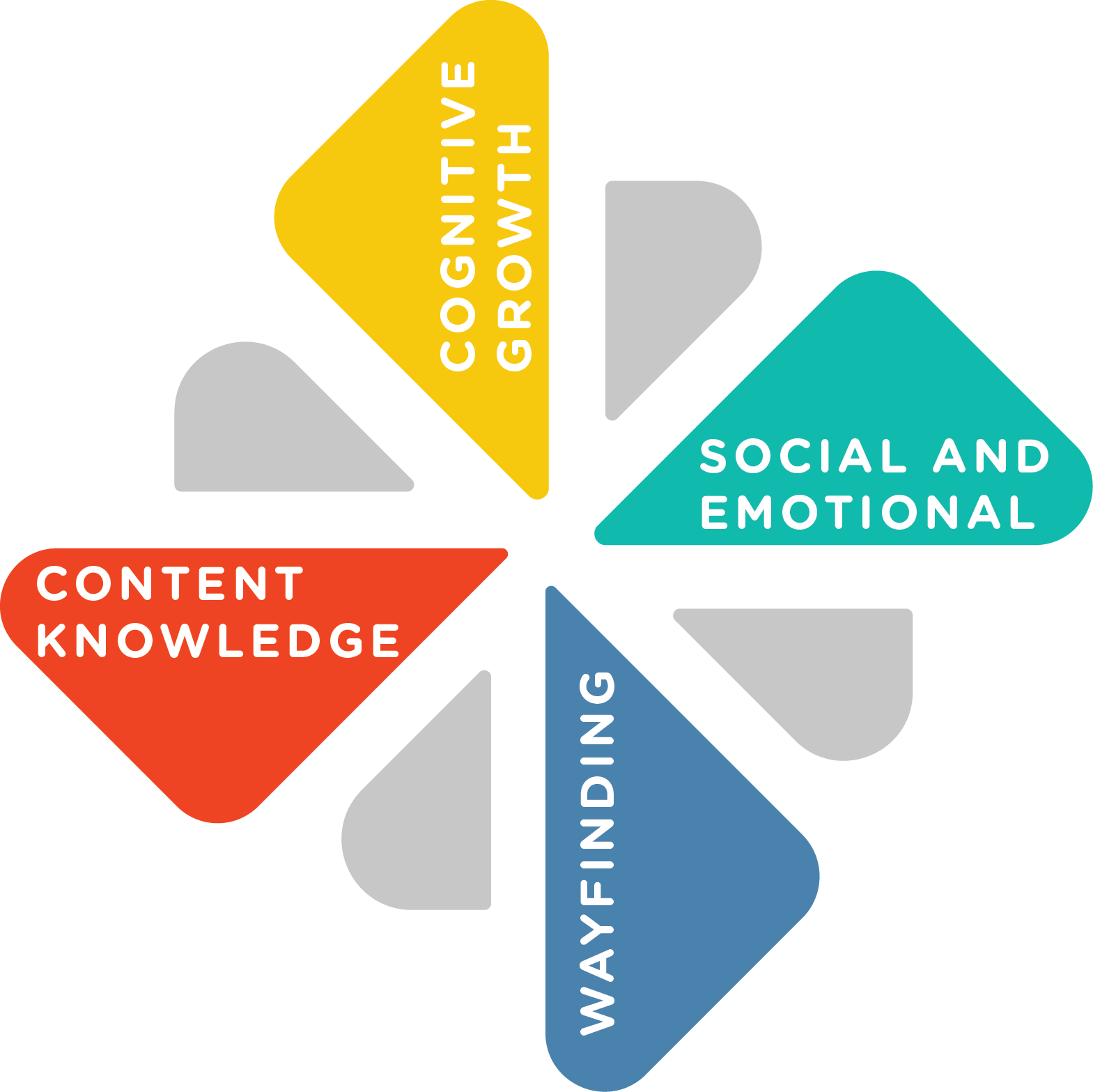
At the heart of this commitment lies our “Whole Child Framework,” which guides our approach towards fostering the holistic development of each learner. This framework comprises four lenses: Social and Emotional Learning, Cognitive Processing, Wayfinding, and Academic Achievement.
Social and Emotional LENS
Our Social and Emotional Learning (SEL) approach centers around cultivating the emotional intelligence and interpersonal skills necessary for thriving in today’s complex world. We kick off each academic year by establishing unique Studio identities, fostering a sense of community and belonging. Our school day starts and ends with community circles, providing a platform for learners to share and celebrate experiences.
Our focus extends to building a positive sense of self through reflective practices, instilling resilience, and fostering a growth mindset. Emphasizing self-discipline, time management, and resource allocation, we equip learners with crucial life skills for personal and academic success.
Beyond individual development, we also promote empathy and understanding, creating a compassionate and inclusive community. Through collaborative learning, we aim to prepare students not only for academic growth but also to emerge as emotionally intelligent, socially aware, and collaborative individuals, shaping a holistic educational experience at Phoenix Modern.
Self-Awareness
The ability to accurately recognize one’s own emotions, thoughts, and values and how they influence behavior. The ability to accurately assess one’s strengths and limitations, with a wellgrounded sense of confidence, optimism, and a “growth mindset.” (SEL Competencies, www.casel.org)
Skills include:
- Identifying emotions
- Self-identity
- Self-esteem
- Self-efficacy
Self-Regulation
The ability to successfully regulate one’s emotions, thoughts, and behaviors in different situations — effectively managing stress, controlling impulses, and motivating oneself. The ability to set and work toward personal and academic goals. (SEL Competencies, www.casel.org)
Skills include:
- Impulse control
- Mindfulness
- Self-discipline
- Self-motivation
Social Awareness
The ability to take the perspective of and empathize with others, including those from diverse backgrounds and cultures. The ability to understand social and ethical norms for behavior and to recognize family, school, and community resources and supports. (SEL Competencies, www.casel.org)
Skills include:
- Perspective-taking
- Empathy
- Appreciation for diversity
- Ethical responsibility
Relationships
The ability to establish and maintain healthy and rewarding relationships with diverse individuals and groups. The ability to communicate clearly, listen well, cooperate with others, resist inappropriate social pressure, negotiate conflict constructively, and seek and offer help when needed. (SEL Competencies, www.casel.org)
Skills include:
- Sense of belonging
- Communication
- Social engagement
- Relationship building
- Spirit of collaboration
COGNITIVE PROCESSING LENS
At Phoenix Modern, our unique approach goes beyond what children think to focus on how they apply, synthesize, and create using their knowledge and skills, ensuring the development of critical thinking abilities beyond conventional academic boundaries. Central to our philosophy is the hands-on learning experience in Quests, encouraging curiosity, exploration, and problem-solving with an emphasis on collaborative learning. Reflection is key, fostering self-awareness and contributing to continuous improvement. Recognizing the importance of flexible cognitive skills in our ever-changing world, we actively promote an approach that values learning, sensemaking, and pattern seeking. Our commitment to divergent thinking aims to cultivate knowledgeable individuals and deep thinkers capable of navigating the complexities of the world with curiosity, creativity, and critical insight.
Active approach to learning
(problem solving, curiosity, etc., taking risks, using all the sense to collect data), design thinking
Skills include:
- Attends to the enviornment
- Develops questions
- Communicates learning
- Reflects on learning (metacognition)
Sensemaking and pattern seeking
Remembers, connects experiences (applying past knowledge to new situations), classifies experiences, applies prior knowledge to new situations- analysis and reasoning, systems thinking
Skills include:
- Recognizes and recalls
- Gathers relevant data using all senses
- Classifies data
- Analyzes and looks for patterns in data
Imagination
The ability to translate goals into prototype experiences for each new stage or transition, especially the transition from high schooler to independent, contributing adult. Addressing this competency includes helping students to: translate goals into action plans for each new stage or transition; iterate and refine the plans through action — starting with “junior versions” or “prototypes” of work, learn, or civic activities; and move to the next loop of the plan, adapting it based on feedback and lessons learned from the first loop (NextGen, MyWays)
Skills include:
- Seeks possibilities
- Makes connections
- Creates
- Thinks divergently
WAYFINDING LENS
At Phoenix Modern, we prioritize empowering learners with agency and responsibility through our Wayfinding philosophy. This approach involves developing plans for goal achievement, fostering organizational and strategic thinking skills crucial for navigating life’s complexities.
By guiding learners to identify their values, beliefs, and strengths, we empower them to navigate the world with self-awareness. Simultaneously, we encourage setting meaningful goals, teaching learners to proactively secure resources, including support from peers and mentors, fostering self-reliance and community interconnectedness.
Our philosophy extends to instilling a sense of connection to the broader world, encouraging learners to make positive contributions to their community and fostering a commitment to social betterment. Ultimately, by providing agency and responsibility, we cultivate a generation deeply connected to the world, equipped with essential skills for purposeful living and ethical decision-making, poised to navigate life’s journey with a sense of purpose and social responsibility.
Connectedness
The child feels a sense of belonging to the community and to the world as a whole. The child feels love and compassion for others. The child believes that he or she is responsible for contributing to making the community and the world a better place.
Skills include:
- Feels connected to the world
- Feels responsible for making the world a better place
Sets personal goals
The self-awareness, focus, and strategic thinking needed to cultivate individual strengths, identify and pilot opportunities, and set personal goals for learning, work, and life. Addressing this competency includes helping students to: develop self-knowledge, through self-directed,
authentic learning activities, as well as to access tools to diagnose strengths, interests, and personality traits; identify learning, work, and life opportunities likely to match these abilities by focusing on the intersection of assets, aspirations, and market realities; and create goals that point in a longer-term direction, but include interim steps. (NextGen, MyWays)
Skills include:
- Identifies values, beliefs, and strengths
- Sets meaningful personal goals
Find resources
The ability to identify, locate, and secure the time, money, materials, organizations, mentors, and partners needed to support their plans. Addressing this competency includes helping students to: identify what resources they need; develop the help-seeking mindset and skills to successfully secure them; build the social capital needed to support all steps in the Wayfinding process, including mentors, role models, weak tie contacts, and strong family and friend supports; and deploy these relationships into a professional network that enables them to tap insights, find better opportunities, and make better career decisions.
Skills include:
- Identifies people and resources needed to achieve a goal
- Appropriately communicates needs
- Secures resources needed to achieve a goal
Navigate journey
The ability to implement plans in the worlds of education, work, and life, making mid-course adjustments
as required based on new experience. Addressing this competency includes helping students to: grow personal traits related to adaptability and flexibility; develop and practice more specific skills related to pivoting, reframing, and changing direction; strengthen their ability to accurately appraise and take on risk as they pursue professional opportunities; and develop the skills necessary to navigate systems while dealing with discrimination or other challenges.
Skills include:
- Develops plans
- Implements plans
- Reflects on plans
- Responsible decision making
aCADEMIC ACHIEVEMENT LENS
At Phoenix Modern, we uphold our commitment to holistic development while acknowledging the crucial role of academic achievement in a child’s educational journey. Our interdisciplinary Quest units exemplify our dedication to academic depth by encouraging a holistic exploration of subjects, fostering a profound understanding of the interconnectedness of knowledge. To achieve academic excellence, we provide independent math tracks, allowing learners to progress at their own pace and embrace individualized learning. The unique implementation of multi-age studios creates mentorship opportunities, fostering a collaborative environment where younger learners benefit from mentors, and older children become academic leaders, developing essential leadership skills. At Phoenix Modern, academic achievement is seamlessly integrated into a larger educational narrative, offering flexible and personalized learning paths, cross-curricular exploration, and a multi-age studio environment that transcends traditional metrics, ensuring a comprehensive and enriched academic experience for our learners.
Interdisciplinary Quest
Our interdisciplinary Quest units promote a profound understanding of subjects, connecting knowledge across various domains.
The goal of Quest is to help learners explore diverse stories of history using a critical lens. Quest also allows learners to dive into the workings of the world and examine their world closely. Quests are multi-week, interdisciplinary projects that culminate in a learner-run exhibition. We approach our quest design using an inquiry approach, asking questions and posing problems. The guide begins with broad topics that are aligned to Arizona’s state standards and develops an initial set of learning experiences. This approach allows for Quests to be more “emergent,” growing with learners’ wonderings and interests.. As children engage with these experiences, the guide steps into the role of researcher, investigator, and facilitator.
Quest topics are determined from Arizona Science and Social Studies Standards. Quests align to the following big ideas:
Civics and Economics
Local Community
Global History and Geography
Physical Science
Earth and Space Science
Life Science
Standards from English Language Arts Reading and Writing are woven into the quests as learners conduct research and create written presentations to publicly display their learnings.
Math Workshop
The goal for Math Workshop is for learners to understand the language of numbers and represent their world through mathematics. Learners interact with math content in a variety of formats. In general, all Studios have learners engage in small or whole-group mini-lessons using math talks and CGI (cognitively guided instruction) strategies. This is followed by independent individual work using a digital learning platform. All Studios have a Math Center with games, hands on-materials, and manipulatives.
Our digital math curriculum includes:
Dreambox
Zearn
IXL
Our printed math curriculum includes:
San Fran Unified School District Math (SFUSD)
Zearn
Mindset Mathematics
Literacy Workshop
The goal of Literacy Workshop is for learners to develop as readers and writers who can share stories and information with the world. During Literacy Workshop, learners learn reading/writing standards through a mini-lesson where they study genre-specific mentor texts followed by independent time for reading and/or writing. Guides facilitate read-alouds throughout the day with various books and texts at or above “grade-level.” Elementary learners receive targeted systematic instruction through Lexia and during Guided Reading small groups.
Whenever possible, Quest topics are used as an anchor for applying English Language Arts Reading and Writing skills as learners conduct research and create written presentations to publicly display their learnings. This not only deepens their understanding of the Quest topic but also cultivates their proficiency in essential literacy skills.
Our digital literacy curriculum includes:
Lexia Core5
Epic Books
Our printed curriculum includes:
Open Up Resources Bookworms
Lucy Calkins Units of Study
Assessment
Our Program
Designed for today. Learn more about our modern, whole-child approach to learning.
Apply
We are accepting applications on a rolling admissions basis. Please reach out to us to check availability for your preferred grade level.
Schedule a Tour
The best way to learn about Phoenix Modern is to visit our campus and see learners and guides in our unique learning environment.
Contact Us
discover@phoenixmodern.org
Student Academic Records
Contact our Registrar
records@phoenixmodern.org
Our Campus
200 E. Mitchell Dr.
Phoenix, AZ 85012

Contact Us
Email Us
(480) 779-3117
Student Academic Records
Contact our Registrar
Email Us
(480) 779-3117
Our Campus
200 E. Mitchell Dr.
Phoenix, AZ 85012